Chimney Repair Around the Muskego Lakes
Chimney Repair in Muskego, WI
Describe what you’re seeing on your chimney and ask about service in Muskego. Asking is free and you’re under no obligation.
Chimney Repair Around the Muskego Lakes
Describe what you’re seeing on your chimney and ask about service in Muskego. Asking is free and you’re under no obligation.
Muskego is the largest community this site covers, a Waukesha County city of about 25,000 people spread across farmland, subdivisions and three lakes. Most of its homes are younger than those in the older river villages to the south. Census estimates put the median home here in the late 1980s, so the typical Muskego chimney is a brick or stone-veneer fireplace chimney on a 1970s through 2000s house, or a factory-built fireplace inside a framed chase with a metal cover. Older farmhouses and lake cottages fill in the rest. All of them sit through the same Southeast Wisconsin winters, with snow, ice and repeated freeze-thaw cycles working water into masonry and seams.
Muskego’s chimneys have reached the age when the first big repairs come due. Crowns poured when the house was built start to crack, original flashing lets go, galvanized chase covers rust through and mortar joints above the roofline erode. The city grew from a farming town into a Milwaukee bedroom community, and it became a city in 1964, absorbing the crossroads settlements of Durham Hill and Tess Corners. The name comes from a Potawatomi word for sunfish, a fitting origin for a place shaped by Big Muskego Lake, Little Muskego Lake and Lake Denoon.
Little Muskego Lake, about 506 acres and up to 65 feet deep, is the most built-up shoreline in the city. Homes around it range from small cottages from its resort days to large newer houses. From 1861 to 1967 the Muskego Beach amusement park drew crowds to its south shore, later reopening as DandiLion Park until 1977, and the cottages and summer homes of that era still turn up around the lake. Many have been expanded and converted to year-round living, often with chimneys that were built for occasional fires and now see regular use.
Big Muskego Lake, about 2,260 acres, is shallow and marshy, and much of its shoreline is natural rather than lined with homes. Lake Denoon, about 162 acres, straddles the line with the Town of Norway at the city’s south end. Between the lakes, Muskego’s subdivisions fill the land that was once farm fields, with homes from the 1970s onward. These neighborhoods hold most of the city’s fireplace chimneys, including many brick or stone-veneer chimneys and framed chases built in the 1990s and 2000s.
Muskego’s oldest buildings survive along the old roads. The brick Tess Corners School still stands at Janesville Road and Durham Drive, and the Muskego Historical Society’s Old Settlement Centre on Racine Avenue preserves the old town hall on the former Hohensee farm. Farmhouses along the city’s rural roads often have tall brick chimneys that have weathered generations of winters. Across the 53150 zip code, Muskego chimneys share the same pressures: freeze-thaw cycles, wet lakeside conditions and original materials that are reaching the end of their service life.
Many Muskego crowns were poured or troweled when the house was built in the 1980s or 1990s. After 30 or more winters, hairline cracks open up, water gets in and freeze-thaw widens them every year. Chimney crown repair can seal or replace a crown before the damage spreads to the brick.
Framed chases with factory-built fireplaces are common in Muskego subdivisions. Flat galvanized covers rust, sag and hold water, which can leak into the chase and down beside the fireplace. Replacing the cover with a sloped stainless model is a common chase cover fix.
Snow piles up on the uphill side of a chimney, melts during warm spells and refreezes. That water works under aging flashing and shows up as stains on the ceiling or wall near the fireplace. See chimney leak repair.
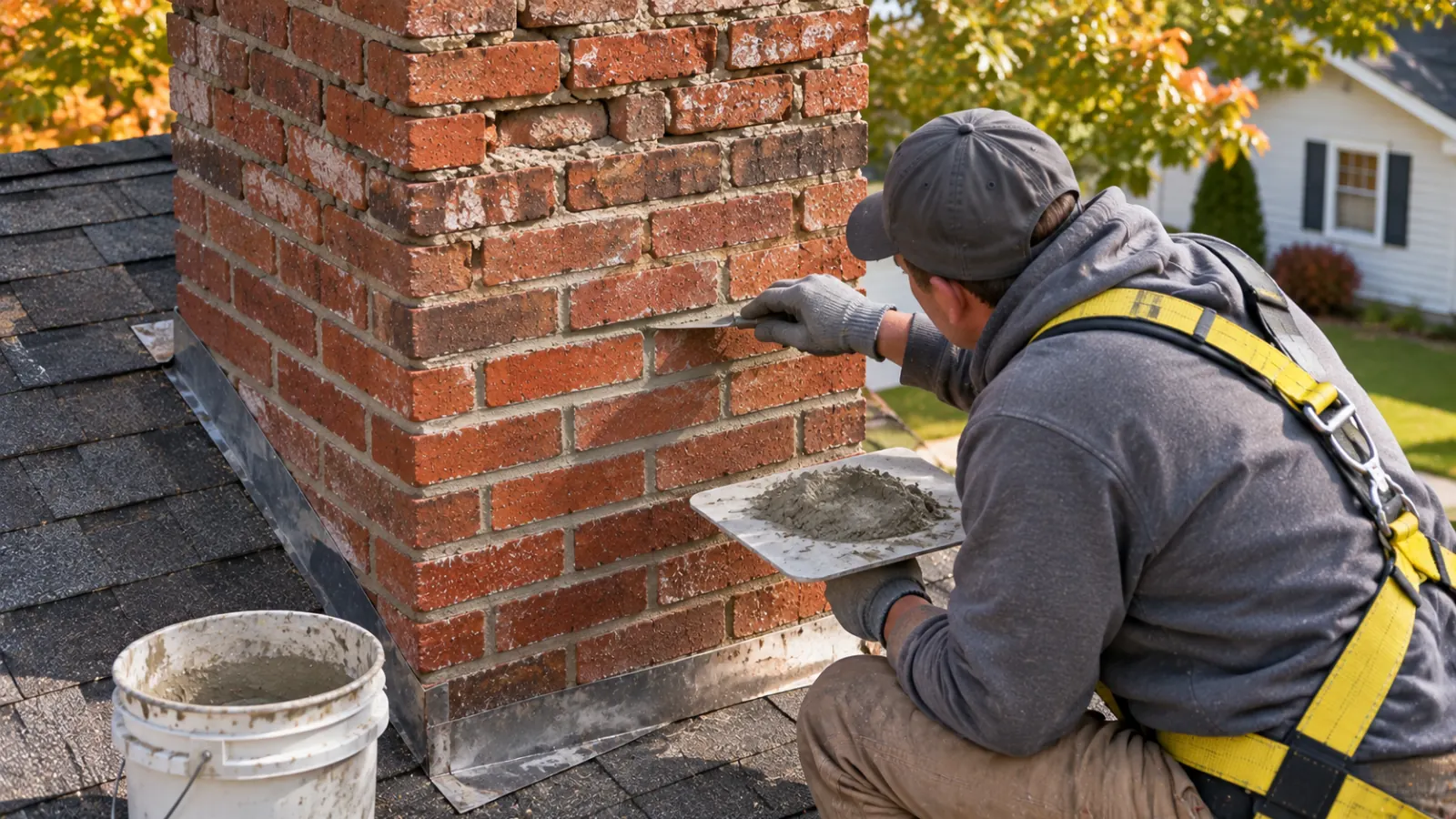
The part of the chimney above the roofline takes the worst of the wind and weather. Sandy, recessed joints on the top courses are a sign it’s time for tuckpointing and masonry repair before bricks loosen.
A chimney built for weekend fires at a Little Muskego Lake cottage may not be ready for daily heating. Cracked flue tiles, missing liners and old repairs are common and should be checked before a stove or insert goes in.
New high-efficiency furnaces often vent elsewhere, leaving a water heater alone in an oversized flue, and new inserts need a properly sized liner. Chimney liner repair and relining fits the flue to the appliance.
Solid brick, stone veneer and framed chases fail in different ways. An estimate should match the construction of your chimney, not a one-size-fits-all fix.
Water that shows up near the fireplace can start at the cover, crown, flashing or veneer. The repair should stop water where it gets in, not just where it shows up.
Mortar and concrete need above-freezing temperatures to cure properly. Book crown and brick work for late spring through early fall, before heating season.
Ask what materials are proposed, how much of the chimney the work covers and how hidden damage, like rotted chase framing, would be priced. Confirm service for your Muskego address first.
Most Muskego chimneys are young enough that repair is the answer: a new crown or crown seal, new flashing, a stainless chase cover, a cap, tuckpointing of the top courses or a liner for an insert. Repair makes sense when the masonry or chase framing is sound and the damage is limited to one area.
A chimney rebuild becomes worth discussing when the brick above the roofline is loose, leaning or badly spalled, or when years of leaks have rotted the framing inside a chase. Farmhouse chimneys on Muskego’s rural roads and older lake cottage chimneys are the most likely candidates. Homeowners in nearby Wind Lake and Mukwonago face many of the same lake-area issues.
Learn more about each type of chimney repair work:
The City of Muskego’s Building Inspection office in the Community Development department handles permits. The city’s permit guide says a building permit is required for alterations and structural repairs, and separate electrical, mechanical or plumbing permits may apply. A rebuild or new fireplace is more likely to need one than a simple crown seal. Ask whoever does the work and confirm with the city.
Yes. Thirty-plus Wisconsin winters is long enough for an original crown to crack, flashing sealant to fail and a galvanized chase cover to rust. Catching these early is usually far less expensive than repairing the water damage they cause inside the chimney or chase.
Not until the chimney has been inspected. Cottage chimneys around Little Muskego Lake and Lake Denoon may have gone years without use, and nests, cracked flue tiles or missing liners are common. A Level 2 inspection, which includes a camera look inside the flue, is the standard check after a home sale.
That is usually a sign the metal chase cover on top is rusting. Once it rusts through or sags, water can pool and leak into the chase. Replacing it with a sloped stainless cover, and checking the framing underneath for rot, is the typical repair.
Have a leaking chase, cracked crown or crumbling mortar in Muskego? Call or request an estimate and describe what you’ve noticed.
Free — no obligations